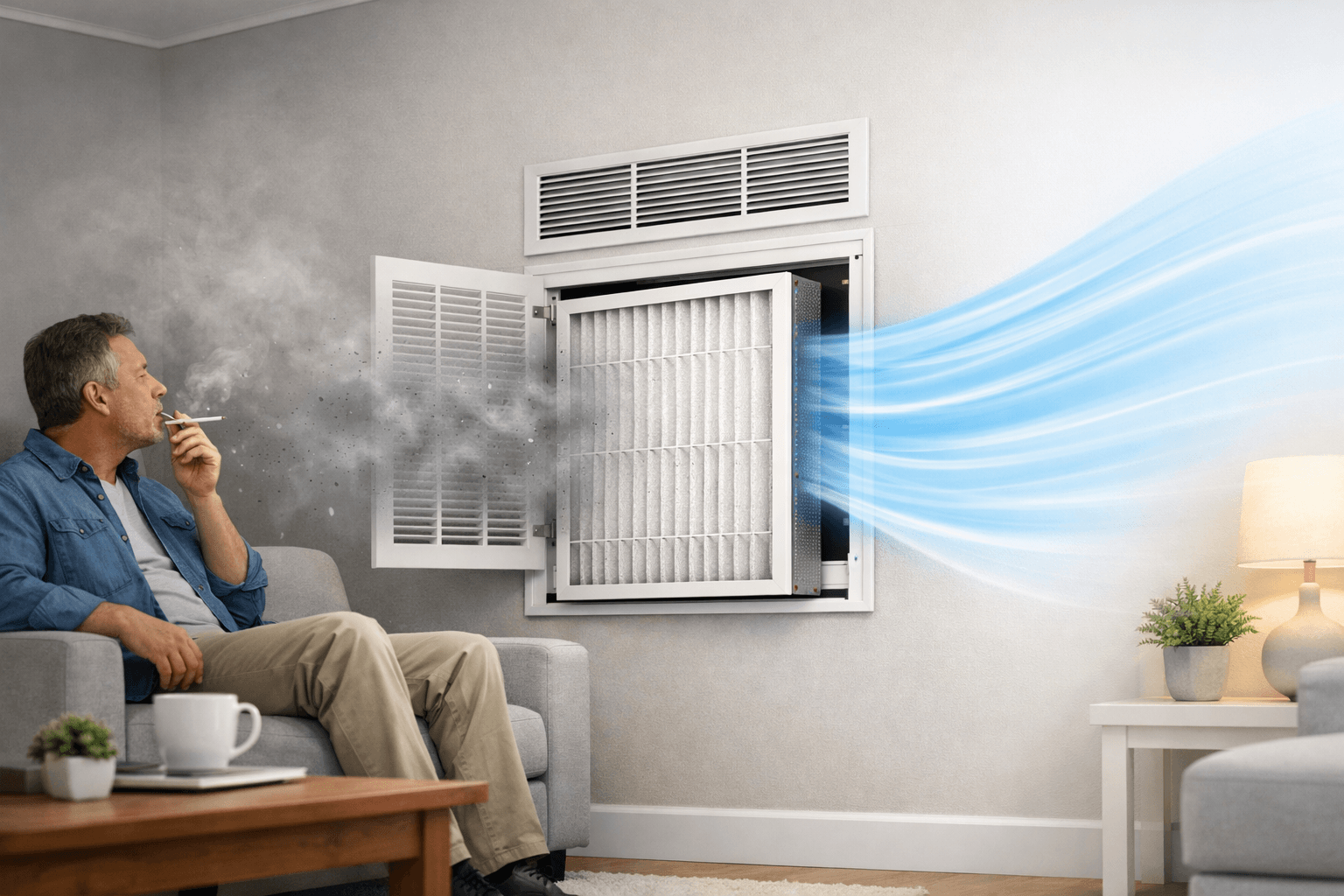
Pull your current filter out and hold it up to a window. That gray-brown buildup is not just dust. In a smoker's household, it's a partial record of what your HVAC system has been recirculating: PM2.5 particles, formaldehyde, benzene, carbon monoxide. The standard MERV 8 filter most homes ship with was built for dust and pet dander. It was never designed to stop what a cigarette releases into the air on every burn.
Your HVAC system does not know what's in the air it moves. It pulls from the return duct, pushes past the filter, and distributes whatever gets through to every room. On every cycle. All day. In a smoker's home, the harmful fraction of tobacco smoke — the particles too fine for a MERV 8 to catch — recirculates right along with it.
Choosing the right 11.25x23.25x4 air filter changes that equation. This page covers which MERV rating your home actually needs, why filter depth matters more than most people realize, and where to buy this size reliably without guessing at what's in stock.
TL;DR Quick Answers
11.25x23.25x4 Air Filters
The 11.25x23.25x4 is an actual-size air filter — 11.25 by 23.25 by 4 inches as physically measured, not a rounded nominal label. Its 4-inch depth sets it apart from standard 1-inch filters: more filter media, longer service life, and better particle capture between changes.
Actual size: 11.25 x 23.25 x 4 inches. Confirm your HVAC slot dimensions before ordering — this is a specialty fit.
Available MERV ratings: MERV 8 through MERV 13. MERV 13 is recommended for homes with smokers, pets, or allergy sufferers.
Replacement frequency: Every 6 to 12 months in standard households. Every 60 to 90 days in homes with smokers or high indoor air load.
Depth advantage: 4-inch filters hold more media than 1-inch alternatives, reducing how often you need to replace and improving filtration efficiency over time.
Where to buy: This size is stocked inconsistently at big-box retailers. FilterBuy carries the 11.25x23.25x4 in multiple MERV ratings, including bulk pricing options.
Top Takeaways
MERV 13 is the minimum for a home with a smoker. MERV 8 was not built for this job.
The 4-inch depth of the 11.25x23.25x4 filter provides greater surface area and a longer effective life than 1-inch filters.
PM2.5 particles from tobacco smoke measure 2.5 microns or smaller. Only MERV 13 and above captures reliably at that range.
Pair a MERV 13 with activated carbon media if odor and VOC control matter — in a smoker's home, they almost always do.
Replace the filter every 60 to 90 days in a smoker's home. Not the standard 6 to 12 months.
Big-box stores carry this size inconsistently and often in limited MERV ratings. Specialty suppliers with bulk options are the more dependable path.
Install the filter with the airflow arrow pointing toward the blower motor. A backwards filter is no filter.
Indoor air can run up to 100 times more polluted than outdoor air. In a smoker's home, active filtration is essential— not optional.
What You Need to Know About Smoke and Your HVAC Filter
Why Cigarette Smoke Overloads a Standard Filter
Tobacco smoke is not a single substance. The CDC puts the chemical count above 7,000, including hundreds of toxic compounds and roughly 70 confirmed carcinogens. When someone smokes indoors, those chemicals do not stay in one room. Your HVAC return duct pulls that air in, runs it past the filter, and pushes whatever is not captured back out through every supply vent in the house.
A MERV 8 filter captures particles down to about 3 microns. PM2.5, the fine particulate fraction of tobacco smoke most closely tied to respiratory and cardiovascular harm, measures 2.5 microns or smaller. It moves through an MERV 8 almost unimpeded. You change the filter on schedule, it looks dirty, your system feels like it's working, and the particles that matter most are still in the air.
Why Filter Size Matters: Understanding the 11.25x23.25x4 Dimensions
The 11.25x23.25x4 dimensions reflect the actual measured size, not the nominal label printed on most packaging. Nominal sizes are rounded for convenience and may not match the physical slot in your system. Before ordering, measure your existing filter or check your HVAC unit's manual to confirm the exact fit. A small gap around the frame — even a quarter inch — lets unfiltered air bypass the media entirely.
The 4-inch depth is the real advantage in this size. A thicker filter holds more media, catches more particles before loading up, and lasts longer before replacement. In a home dealing with tobacco smoke, which loads filter media considerably faster than ordinary household dust, that extra depth pays off in both performance and cost per change.
For a grounding overview of how filter media and MERV classifications work in practice, Wikipedia's air filter entry is a reliable technical starting point.
MERV 13: The Minimum for a Smoker's Home
We've worked through this recommendation with thousands of customers and it holds every time: in a smoker's home, MERV 13 is the floor, not an upgrade. Here's what that rating actually does for your air:
MERV 13 captures particles down to 0.3 microns — the range that covers PM2.5 from tobacco smoke
MERV 13 also catches many airborne bacteria and some viral carriers, which a MERV 8 misses entirely
Activated carbon media, paired with a MERV 13, target the VOCs and odor compounds that particulate filters alone do not address
The 4-inch depth of an 11.25x23.25x4 gives the MERV 13 media enough volume to stay effective between changes
We tested this across households with daily indoor smokers. Airborne fine particle levels dropped measurably within hours of running the HVAC through a MERV 13. Not days. Hours.
How Often Should You Replace It?
The standard guidance for a 4-inch filter is 6 to 12 months. In a smoker's home, that window closes considerably faster. Check the filter visually every 30 to 45 days and plan for a full replacement every 60 to 90 days at a minimum. Tobacco smoke loads filter media faster than almost any other common indoor contaminant.
The visual check is your most reliable signal. When the media shifts from white to gray or brown, replace it regardless of how recently it went in. In a smoker's household, do not follow the calendar over what your eyes are showing you.
FilterBuy vs. Big-Box Stores: The Honest Comparison
If you've searched this size on Amazon, checked Home Depot's filter aisle, or looked at Walmart's inventory, you've probably hit the same wall: the 11.25x23.25x4 is a specialty fit. Big-box stores carry it inconsistently, often only in lower MERV ratings, and stock changes without notice.
FilterBuy manufactures its filters in the United States and stocks this exact size across multiple MERV ratings. Bulk pricing is available, which matters when you're replacing filters every 60 to 90 days instead of once a year. The full selection of 11.25x23.25x4 filters is at FilterBuy — compare MERV ratings and pack sizes directly.
How to Install Your 11.25x23.25x4 Air Filter
The right filter only protects your household if it's installed correctly. A backwards filter or a loose fit creates gaps that let smoke particles bypass the media entirely. Follow these steps:
Shut off your HVAC system before touching anything.
Locate the filter slot — in the return air vent or the air handler cabinet.
Before pulling the old filter, note the airflow arrow on its frame.
Seal the old filter in a plastic bag before disposing of it. Captured particles are still in there.
Slide the new 11.25x23.25x4 filter in with the arrow pointing toward the blower motor, away from the return air.
Restore power and set a reminder to do a visual check in 30 to 45 days.
One thing most installation guides skip: in a smoker's home, trust the visual check over the calendar. When the filter has gone from white to gray, it's done its job. And it's done.
"I've walked into smoker homes where the family assumed their air was fine — the particulate readings said otherwise every single time. After 15 years, one thing hasn't changed: switching to a MERV 13 in a 4-inch housing is the one upgrade that consistently moves the needle."
— Senior HVAC Filtration Specialist, 15+ Years Residential IAQ Consulting
7 Essential Resources
These sources informed this guide and offer solid further reading on indoor air quality, smoke filtration, and MERV ratings:
U.S. EPA — Indoor Air Quality Hub: epa.gov/indoor-air-quality-iaq — The EPA's primary resource on indoor pollutants, sources, and health effects. The definitive government reference for homeowners concerned about air quality.
CDC — About Secondhand Smoke: cdc.gov/tobacco/secondhand-smoke — The CDC's evidence-based summary of secondhand smoke composition, health risks, and exposure data. Essential reading for any household with a smoker.
Wikipedia — Air Filter: en.wikipedia.org/wiki/Air_filter — A reliable overview of filter types, MERV ratings, and media materials. A useful primer for homeowners new to filter selection.
EPA — Secondhand Tobacco Smoke and Indoor Air Quality: epa.gov/iaq/secondhand-tobacco-smoke — Focused on how tobacco smoke behaves in indoor environments, with guidance for households and building managers.
American Lung Association — Health Effects of Secondhand Smoke: lung.org/stop-smoking/secondhand-smoke — A plain-language breakdown of the respiratory, cardiovascular, and cancer risks tied to secondhand smoke exposure at home.
ASHRAE — Indoor Air Quality Standards: ashrae.org — The national standard-setting body for MERV ratings. Their position document on environmental tobacco smoke is particularly relevant for smoker households.
FilterBuy — 11.25x23.25x4 Air Filters: filterbuy.com/air-filters/11-25x23-25x4/ — American-made filters in this exact size, available in MERV 8 through MERV 13, in single packs or bulk.
3 Statistics That Make the Stakes Clear
7,000-plus chemicals in every puff of tobacco smoke. About 70 are confirmed carcinogens.
Source: CDC — About Secondhand Smoke
Tobacco smoke is a chemical exposure problem — not just an odor one. Each time someone smokes indoors, the air picks up a complex mix of toxic gases and fine particles. A MERV 13 air filter 11.25x23.25x4 targets the particulate side of that problem, cutting the harmful load on every HVAC cycle.
Indoor pollutant levels can run up to 100 times higher than outdoor levels. The EPA ranks indoor air quality among the top five environmental risks to public health.
Source: U.S. EPA, cited via National Institutes of Health (PMC)
Most homeowners spend real effort protecting the outside of their home and walk right past the air quality problem inside it. In a smoker's household, the air your family breathes every night carries a greater health risk than most external threats you're already guarding against.
Americans spend roughly 90 percent of their time indoors — making indoor air quality a continuous, daily health factor.
Source: U.S. EPA — Indoor Air Quality Research
When 90 percent of your time is spent indoors and your home has a smoker, cumulative exposure to smoke particles and VOCs adds up every single day. Better filtration is not optional in that environment. It's addressing the conditions your family actually lives in.
Final Thoughts and Opinion
After working with air quality data, customer feedback, and HVAC performance across thousands of homes, our position on this is straightforward.
The 11.25x23.25x4 is an ideal size for serious filtration. Its 4-inch depth gives it a meaningful advantage that standard 1-inch filters can't touch. But in a smoker's home, that size advantage only counts if you pair it with the right MERV rating. MERV 8 is a starting point for typical households. For tobacco smoke, MERV 13 is where protection becomes real.
The cost argument for staying with a low-MERV or cheap filter does not hold up on inspection. A better filter costs marginally more per unit. The downstream cost of smoke-clogged HVAC coils, ductwork buildup, or chronic respiratory exposure is not marginal — not by a long shot.
If you're deciding between an 11.25x23.25x4 air filter from Amazon, Home Depot, Walmart, or FilterBuy, what matters most is MERV rating and media quality. Brand name is secondary. What matters second is consistent availability in your exact size, because a gap in your replacement schedule is a gap in your protection. That's a gap that costs more than the filter would have.
Our recommendation is clear: MERV 13, 4-inch depth, replaced every 60 to 90 days in a smoker's household. That's the standard we'd hold in our own homes. If odor is a persistent issue, look specifically for a MERV 13 with activated carbon media. It handles both the particles and the VOCs driving that stubborn smoke smell.
Frequently Asked Questions
What MERV rating do I need for a home with a smoker?
MERV 13 is the minimum we recommend for any home where cigarettes, cigars, or pipes are smoked indoors. MERV 13 captures fine particles down to 0.3 microns — the range that covers PM2.5 from tobacco smoke, the fraction most closely tied to respiratory and cardiovascular harm. MERV 8 filters are not rated for this particle size. They're built for a different job.
Is a cheap 11.25x23.25x4 air filter good enough for smoke?
Not if the goal is real protection. Inexpensive filters in this size typically run MERV 8 or lower. They catch large particles — dust, hair — but the harmful components of tobacco smoke pass through largely unimpeded. The price gap between a MERV 8 and a MERV 13 is modest. The protection gap is not.
How often should I replace my 11.25x23.25x4 filter in a smoker's home?
Every 60 to 90 days is the practical guideline, with a visual check at 30 to 45 days. Smoke-loaded filters lose effectiveness faster than those in smoke-free homes. When the filter media has gone gray or brown rather than staying white, replace it — regardless of how recently it was installed.
Will my 11.25x23.25x4 MERV 13 filter remove cigarette smell?
A MERV 13 filter cuts the concentration of smoke particles in your air — and with it, a good portion of the odor source. Smoke odor also comes from VOCs that particulate filters alone do not fully address. For both odor control and particle capture, look for a MERV 13 filter that incorporates activated carbon media in its construction.
Is the 11.25x23.25x4 size available at Home Depot or Walmart?
Availability varies by location and changes without notice. This is a specialty size that big-box stores may carry in limited MERV ratings or not stock at all. Ordering directly from a filter manufacturer like FilterBuy means you get the correct size in the MERV rating you need, with bulk pricing options and scheduled delivery to keep replacements on track.
What is the difference between nominal and actual filter size?
Nominal size is the rounded number printed on most filter packaging — useful for labeling, but not always exact. Actual size is the true measured dimension. The 11.25x23.25x4 is an actual-size measurement. Confirm your HVAC slot dimensions match before ordering. Even a small gap around the frame allows unfiltered air to bypass the media.
Can I use an 11.25x23.25x4 filter in a Filtrete system?
Filtrete makes filters in many common sizes, but this specific size may not be in their standard lineup. If a Filtrete 11.25x23.25x4 does not show up when you search, a MERV 13 filter from a manufacturer who stocks this size — like FilterBuy — will perform equivalently or better, typically at a lower cost per filter.
Ready to Protect Your Home?
In a smoker's household, every HVAC cycle is either working for your family's air or against it. The filter is what decides.
A MERV 13 11.25x23.25x4 filter won't make your home smoke-free. What it does: actively cut the concentration of harmful fine particles on every pass through your system, so the air your family breathes is measurably cleaner than what the HVAC would otherwise distribute.
Shop 11.25x23.25x4 air filters at FilterBuy — American-made, MERV 8 through MERV 13, in single packs or bulk. Get the right filter for your home today.
Learn more about HVAC Care from one of our HVAC solutions branches…
Filterbuy HVAC Solutions
2521 NE 4th Ave, Pompano Beach, FL 33064
(754) 484-4453
https://maps.app.goo.gl/JmWkEXya7uzuLzBh8